
Loading
Preparing your coverage insights...
Our Locations
Loading
Preparing your coverage insights...
Most drivers compare price but not coverage. Learn how to compare auto insurance quotes the right way: same limits, same deductibles, real discounts.
Get a car insurance quote. One call compares the carriers we write side by side.

Most drivers focus on finding the lowest premium. But the cheapest quote often comes with the lowest coverage, and that can cost far more after an accident. Here is how to compare auto insurance quotes the right way.
Skip the manual comparison
We run this whole checklist for you, on 30+ carriers at once.
Give us your driver and vehicle details once and we quote identical limits, identical deductibles, and the same tort election across every carrier so you are never comparing apples to oranges.
Have these ready before requesting quotes: driver names, dates of birth, and license numbers for everyone in your household; vehicle year, make, model, and VIN; your current policy or declaration page if you have one; and your estimated annual mileage. Having this upfront prevents back-and-forth that slows down the process.
This is where most people go wrong. One quote might show $89/month for 25/50/25 liability limits. Another shows $112/month for 100/300/100. These are not the same product. To compare fairly, request the same coverage type and same limits from every carrier. Otherwise you are comparing apples to oranges and the cheaper one is almost always cheaper because it covers less.
Liability covers damage or injuries you cause to others and is required by law. Collision covers your vehicle after an accident regardless of fault. Comprehensive covers theft, hail, fire, and other non-collision damage. Uninsured motorist (UM/UIM) protects you when the other driver has no coverage or not enough. Medical payments help cover medical bills for you and your passengers after an accident. Rental Reimbursement helps pay for a rental car while your vehicle is being repaired after a covered loss.
None of these coverages follow you while you are logged into Uber or Lyft. If you drive for a rideshare platform, see our rideshare insurance guide for where the coverage gap sits and how to close it before you compare quotes.
Common discounts include multi-policy (bundling auto with home or renters), good driver, good student, defensive driving course completion, low annual mileage, and anti-theft devices. Not every carrier offers every discount, so comparing across many carriers reveals which one gives you the best combined rate for your specific situation.
If you are comparing quotes because you just added a teen driver to the policy, the good student discount alone can offset a meaningful share of the increase.
A lower premium matters less if the carrier is slow to pay claims or disputes coverage. Look at J.D. Power auto claims satisfaction ratings and AM Best financial strength ratings before you decide. A strong carrier with a slightly higher rate is often the better long-term value.
Going direct to one carrier gives you one quote from one company. An independent agent like Dragon Insurance can compare 30+ carriers in one conversation and explain the trade-offs across coverage limits, deductibles, and carrier quality. You get unbiased guidance without spending hours on different carrier websites, and we can often find discounts you would not find on your own.
Ready to compare quotes?
Dragon Insurance shops 30+ carriers across PA, TX, VA, MD, OH, TN, and KY.
Two carriers looking at the identical driver and identical limits will not return the same number, and the gap is often 40 percent or more. That is not a mistake on either side. Every carrier files its own rating plan with the state, and they weight the same inputs differently. One company may treat a single at-fault claim as a three year surcharge while another rates it for five. One may lean heavily on credit-based insurance scoring where another leans on garaging ZIP code and annual mileage.
This is the entire argument for comparing rather than renewing. The carrier that priced you best three years ago, when you had a new car and a clean record, is frequently not the carrier that prices you best today after a move, a teen driver, or a claim. Nothing about your policy tells you when that stops being true, which is why an annual comparison is worth more than any single discount.
If you are comparing quotes in Pennsylvania, one election affects every number you see, and it is easy to miss because it is buried in the application. When you buy a PA auto policy you must choose full tort or limited tort. Limited tort lowers your premium, typically by around $15 to $25 a month, and in exchange you give up the right to sue an at-fault driver for pain and suffering except in cases of serious injury as defined by statute.
The trap when comparing quotes is that one carrier may have quoted you limited tort and another full tort. The limited tort quote will always look cheaper, and it is not the same product. Before you compare two Pennsylvania numbers, confirm both were quoted on the same tort election. Our Pennsylvania car insurance guide walks through the decision in full.
Buying state minimum liability. Pennsylvania minimums are 15/30/5. A single hospital stay can exhaust $15,000 of bodily injury coverage in a day, and anything above your limit is collected from you personally. Raising liability limits is usually the cheapest meaningful coverage you can buy, because severe claims are rare.
Dropping uninsured motorist coverage. UM and UIM pay when the at-fault driver has no insurance or not enough. Given how many drivers on the road are uninsured, removing it to save a few dollars transfers a very real risk back onto you.
Setting a deductible you cannot actually fund. A $2,000 deductible lowers the premium, but only helps if you can produce $2,000 the week of the accident. Match the deductible to your emergency savings, not to the quote you want to see.
Not disclosing every household driver. Leaving a licensed teen or roommate off the policy produces a cheaper quote and a disputed claim. Carriers check household members, and undisclosed drivers are one of the most common reasons a claim gets reduced or denied.
Comparing on price alone and ignoring the claim. The policy only matters on the day you use it. Carrier financial strength and claims handling are part of the product, and the cheapest company in the market is not always the one you want answering the phone after a serious accident.
Doing this yourself, one carrier at a time, means re-entering the same driver and vehicle details into every quote form and then normalizing the results by hand so the limits actually match. Most people abandon that after two or three quotes, which is exactly why the market rewards whoever is still shopping at quote number eight.
An independent agency does the normalizing for you. You provide the information once, and the comparison comes back on identical limits, identical deductibles, and the same tort election, so the only variable left is price and carrier quality. Most Dragon personal auto quotes are ready within an hour.
Ready to see your real numbers
Get your comparison quote today.
One call, 30+ carriers, identical limits across every quote so you can actually compare.
How many auto insurance quotes should I compare?
Three is the practical floor and more is better, because carriers weight the same driver very differently and the spread between the best and worst quote on identical coverage is frequently 40 percent or more. The important part is not the number of quotes but that every one is on the same limits, the same deductibles, and in Pennsylvania the same tort election. An independent agency compares many carriers from one application instead of you filling in one form per company.
Does comparing auto insurance quotes hurt my credit?
No. Insurance carriers use a soft inquiry to pull a credit-based insurance score, and soft inquiries do not affect your credit score no matter how many quotes you request. This is different from applying for a loan or a credit card, which uses a hard inquiry. You can shop your auto insurance as often as you like without any credit consequence.
Why are two quotes for the same coverage so different?
Every carrier files its own rating plan with the state and weights the inputs differently. One company may surcharge an at-fault accident for three years while another does it for five, and one may lean on credit-based insurance scoring where another leans on garaging ZIP code and mileage. Same driver, same limits, genuinely different math. That is why the carrier who was cheapest for you three years ago is often not the cheapest today.
What is the difference between full tort and limited tort in Pennsylvania?
Limited tort lowers your premium, typically by around $15 to $25 a month, and in exchange you give up the right to sue an at-fault driver for pain and suffering except in cases of serious injury as defined by statute. Full tort preserves that right and costs more. When you compare two Pennsylvania quotes, confirm both were quoted on the same election, because a limited tort quote will always look cheaper than a full tort one for reasons that have nothing to do with the carrier.
Should I switch carriers mid-policy or wait for renewal?
You can switch any time. Auto policies are cancellable and the current carrier refunds the unused premium, usually pro rata. Waiting for renewal is convenient but it is not required, and if you have had a major life change such as a move, a new vehicle, a marriage, or a teen driver added, that is the moment your pricing is most likely to be wrong. Never cancel the old policy until the new one is confirmed in force, so you are never uninsured for even a day.
Is the cheapest auto insurance quote usually the right one?
Only if it is genuinely the same product. Most of the time a noticeably cheaper quote is cheaper because it carries lower liability limits, a higher deductible, no uninsured motorist coverage, or in Pennsylvania a limited tort election. Once you normalize all of those, the real spread between carriers is usually much smaller than the raw numbers suggest, and carrier claims handling becomes the tiebreaker.
Explore Related Coverage
Ready to compare carriers and get a quote?
Dragon Insurance is an independent agency in Camp Hill, PA. We shop 30+ carriers to find your best rate.
Prefer to talk it through?
Get a real quote from a licensed advisor. English, Nepali, and Hindi spoken.
About the Author
Bimal GurungCEO, Agency Principal & Licensed Insurance Agent
Bimal Gurung is CEO and Agency Principal of Dragon Insurance Services, an independent agency in Camp Hill, PA that compares 30+ carriers for clients across Pennsylvania, Texas, Virginia, Maryland, Ohio, Tennessee, and Kentucky.
Meet the Dragon Insurance teamContinue Reading
Auto
Cheapest Car Insurance by Driver Profile 2026
18 min read
Auto
Progressive Through an Independent Agent
8 min read
Auto
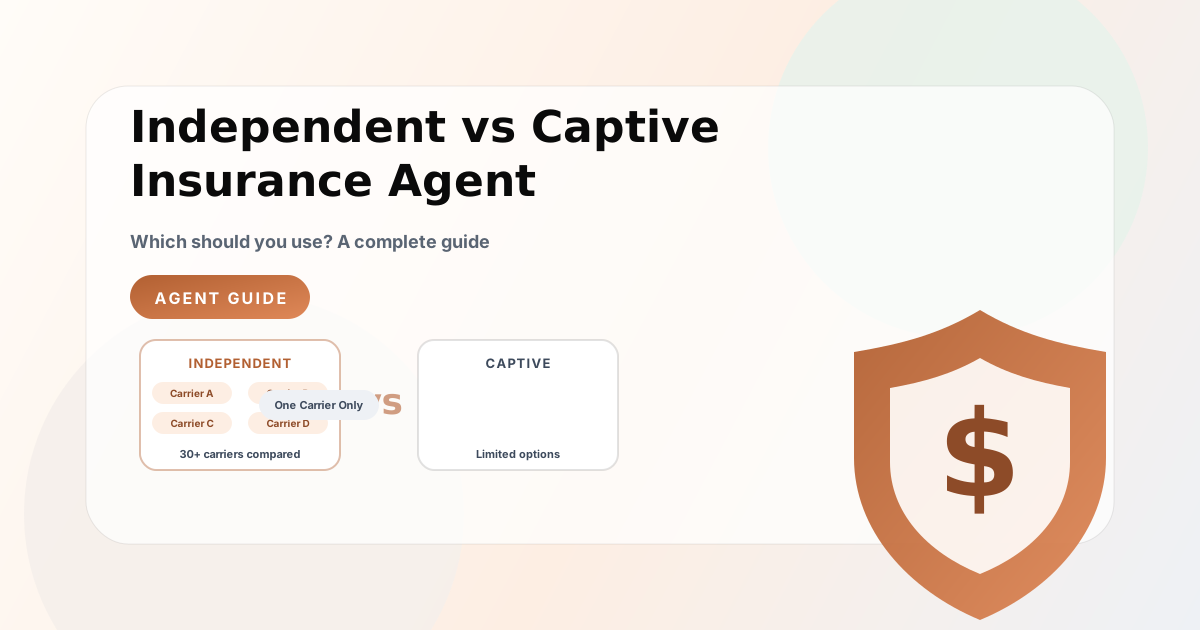
Independent vs Captive Insurance Agent: Which Wins?
7 min read
Auto
Car Insurance Harrisburg PA | Starting Around $50/Mo
7 min read

Auto
Teen Car Insurance: 2026 Costs & Discounts Guide
11 min read
Auto
Rideshare Insurance Guide: Uber & Lyft Coverage
10 min read