Loading
Preparing your coverage insights...
Loading
Preparing your coverage insights...
May 9, 2026
RV insurance covers what auto and homeowners policies miss: personal effects, campsite liability, emergency lodging, and roadside assistance. Covers agreed value vs. ACV, full-timer policies, state minimums for all 7 states, real cost data from Foremost and Progressive, and how to lower your premium.
About 12 million U.S. households own an RV, according to the RV Industry Association, and RV registrations jumped more than 25 percent between 2020 and 2023 as Americans embraced road travel. But most RV owners are underinsured: a standard auto policy does not cover personal belongings inside the coach, campsite liability, or emergency lodging when a breakdown strands you 400 miles from home. A standard homeowners policy does not cover the vehicle itself on the road. Dedicated RV insurance fills both gaps.
Dragon Insurance Services helps RV owners across Pennsylvania, Texas, Virginia, Maryland, Ohio, Tennessee, and Kentucky compare RV specialty policies from carriers like Foremost, Progressive, and National General. This guide covers real cost data, coverage types, full-timer policies, state minimums, and how to avoid the most common coverage gaps.
Key Takeaways
RV insurance is a specialty insurance product that covers recreational vehicles including motorhomes (Class A, B, and C), travel trailers, fifth wheels, camper vans, and pop-up campers. It combines elements of auto insurance (liability, collision, comprehensive) with elements of homeowners insurance (personal property, liability while parked, loss of use) into a single policy designed for how RVs are actually used: as both a vehicle and a temporary or permanent home.
Your standard auto policy covers the RV while it is being driven but provides no coverage for belongings inside, campsite incidents, or emergency lodging. Your homeowners policy covers property at your primary residence but does not follow you to a campsite in the Pocono Mountains or along the Gulf Coast. Dedicated RV insurance is designed to travel with you.
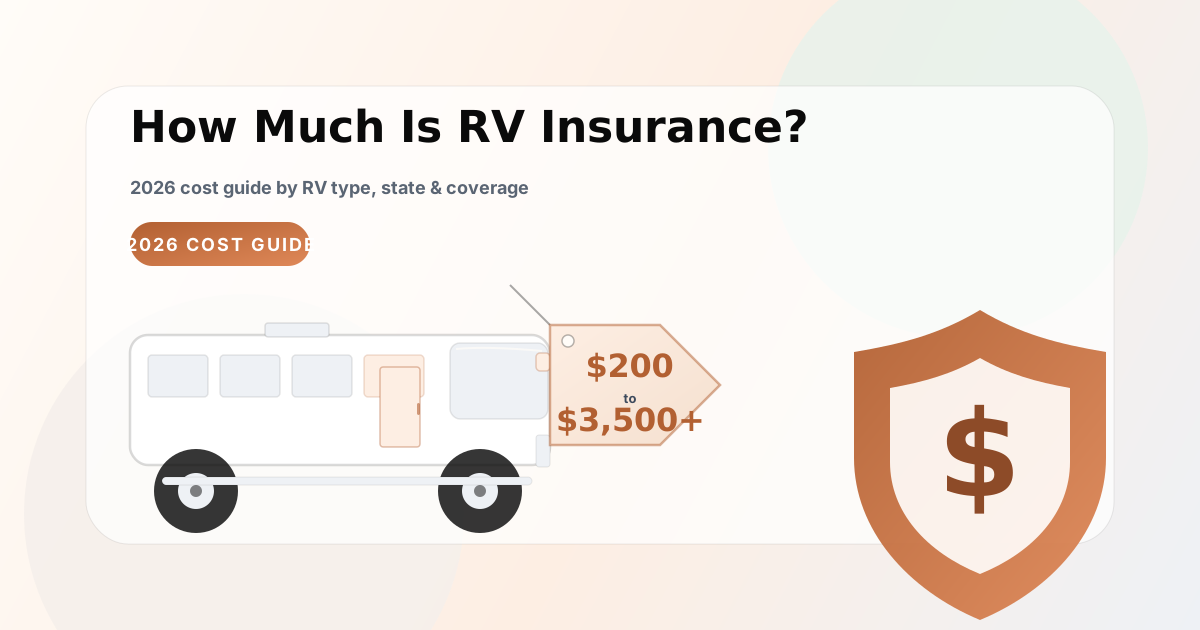
RV insurance costs vary widely because the product covers everything from a $3,500 pop-up camper to a $600,000 Class A diesel pusher. Based on rate data from Progressive and Foremost Insurance, here are typical annual premium ranges for each RV category:
| RV Type | Typical Annual Cost | Key Cost Drivers |
|---|---|---|
| Class A Motorhome | $1,200 to $3,500+ | Vehicle value, mileage, slide-outs, living equipment |
| Class B (Camper Van) | $800 to $1,500 | Conversion quality, mileage, full-time vs. part-time use |
| Class C Motorhome | $1,000 to $2,500 | Length, MSRP, annual mileage, cab-over condition |
| Fifth Wheel | $300 to $1,200 | Value, number of slide-outs, storage location |
| Travel Trailer | $200 to $800 | Trailer value, use frequency, personal effects limit selected |
| Pop-Up Camper | $100 to $300 | Replacement cost, deductible, storage type |
Source: Progressive RV Insurance and Foremost Insurance rate guidance. Actual premiums depend on your driving record, state, RV age, coverage selections, and annual use. Full-timer endorsements add $200 to $600+ annually.
The type of RV you own determines what coverage structure applies and what is legally required. The most important distinction is motorized versus towable, because motorized RVs are regulated as motor vehicles and require their own liability policy.
| RV Type | Motorized or Towable | Liability Requirement | Coverage Approach |
|---|---|---|---|
| Class A Motorhome (bus-style coach) | Motorized | Own policy required | Dedicated RV motorhome policy with state-minimum liability |
| Class B (camper van, Sprinter conversion) | Motorized | Own policy required | RV specialty policy or standard auto with endorsements |
| Class C Motorhome (cab-over design) | Motorized | Own policy required | Dedicated RV motorhome policy, same as Class A structure |
| Fifth Wheel | Towable | Tow vehicle covers in transit | Separate towable policy for physical damage, contents, campsite liability |
| Travel Trailer | Towable | Tow vehicle covers in transit | Separate towable policy for physical damage and personal effects |
| Pop-Up Camper / Folding Trailer | Towable | Tow vehicle covers in transit | Homeowners endorsement or dedicated trailer policy |
A comprehensive RV policy combines multiple coverage types. Understanding each one helps you build the right policy rather than paying for what you do not need or going without what you do.
Required by law for all motorized RVs. Covers bodily injury and property damage you cause to others while driving. State minimums are low, often 15/30/5 in Pennsylvania. Most RV owners who have financed or own a high-value coach should carry at least 100/300/100 limits, since a Class A motorhome involved in a serious accident can generate claims that quickly exceed state minimums. Towable RVs use the tow vehicle liability for transit, but a specialty policy adds campsite liability when you are parked.
Collision covers repair costs after an accident regardless of fault. Comprehensive covers non-collision events: fire, theft, hail, wind, vandalism, and animal strikes. Both are typically required by lenders if the RV is financed, and both are strongly recommended for any RV worth more than $15,000 to $20,000. A Class A coach can cost $300 to $1,000 per foot for body repairs after a slide-out accident.
Covers clothing, electronics, bikes, kayaks, cookware, and other belongings stored inside your RV, both while traveling and while parked. Standard auto policies exclude personal property inside a vehicle. Homeowners policies cover personal property but only at your primary residence. RV personal effects coverage fills this gap. Standard limits range from $3,000 to $10,000; full-timers should select $25,000 to $50,000+ since everything they own is in the coach.
If your RV is damaged in a covered accident while you are traveling and it becomes uninhabitable, emergency expense coverage pays for hotel and meals while repairs are completed. This is the RV equivalent of loss-of-use coverage on a homeowners policy. Without it, you pay out of pocket while your coach sits in a repair shop for six to twelve weeks, which is the typical turnaround for major RV body work.
Covers your liability while parked at a campsite: a guest injured at your site, an awning that collapses on a neighboring camper, a campfire that spreads. Auto liability covers you while driving; homeowners covers you at home. Neither covers you in between, which is where campsite liability steps in. Full-timers need vacation liability at permanent campsite locations, which goes further than standard campsite liability.
Towing a large Class A motorhome or fifth wheel to a service facility costs $500 to $1,500+ without coverage, according to RV industry roadside-service pricing data. RV-specific roadside assistance also covers lockout service, jump starts, tire changes, and fuel delivery. Standard auto-club roadside memberships often have towing distance or vehicle-weight limits that leave RV owners stranded mid-trip; RV-specific coverage avoids those caps.
Some carriers offer total loss replacement for newer RVs, paying for a brand-new unit of the same or similar type in the first one to three years of ownership. This is significantly better than ACV or agreed value for new coaches, since a new $150,000 fifth wheel can lose 20 to 30 percent of its value the moment it is towed off the lot.
When insuring a high-value motorhome or fifth wheel, the valuation method on your policy determines what you actually receive if the unit is totaled. This is one of the most consequential coverage decisions RV owners make, and one of the most commonly overlooked.
| Valuation Method | What You Receive at Total Loss | Best For |
|---|---|---|
| Actual Cash Value (ACV) | Depreciated market value at time of loss (replacement cost minus depreciation) | Older RVs with significant mileage; pop-up campers and lower-value trailers |
| Agreed Value | Fixed dollar amount agreed at policy inception, no depreciation applied | High-value coaches, vintage Airstreams, fully customized fifth wheels |
| Total Loss Replacement | Brand-new replacement unit of like kind and quality (typically years 1 to 3) | New RV purchases where gap between ACV and replacement cost is largest |
A 10-year-old Class A motorhome purchased for $200,000 may have an ACV of $60,000 to $80,000. If you insured it under an agreed value policy for $120,000, that is what you receive at a total loss. The difference can be the ability to purchase a comparable replacement unit or absorb a significant financial loss. Ask us which valuation method is available from each carrier for your specific RV.
Approximately one million Americans now live in their RVs full time, according to estimates from the U.S. Census Bureau, with the number rising steadily since 2020. Standard recreational RV insurance is designed for seasonal use, typically assuming 150 to 180 days of active use per year. If your RV is your primary residence, that product is the wrong fit, and a claim can be denied or underpaid because the insurer considers you outside the policy's intended use case.
Full-time RV insurance is a specialty product built for people living in their RV six or more months per year. Key differences from recreational coverage:
Full-timer endorsements typically add $200 to $600 per year to a base RV policy. The additional cost is almost always worth it for anyone living in their RV the majority of the year. Tell us how many months you plan to live in your RV. That single fact changes which product is right for your situation.
Self-propelled motorhomes (Class A, B, and C) are classified as motor vehicles and must carry state-minimum liability coverage whenever driven on public roads. These are the current minimums across all seven states Dragon Insurance serves:
| State | Min. Bodily Injury Liability | Min. Property Damage | Additional Notes |
|---|---|---|---|
| Pennsylvania | $15,000 / $30,000 | $5,000 | First party benefits ($5,000 min) also required. PA uses choice no-fault system. |
| Texas | $30,000 / $60,000 | $25,000 | Uninsured/underinsured motorist coverage strongly recommended; high UM rates statewide. |
| Virginia | $30,000 / $60,000 | $20,000 | Uninsured motor vehicle fee option eliminated; full coverage now mandatory. |
| Maryland | $30,000 / $60,000 | $15,000 | PIP coverage available; UM/UIM required to be offered at same limits as liability. |
| Ohio | $25,000 / $50,000 | $25,000 | UM coverage must be offered; financial responsibility law applies to RVs over 2 tons GVWR. |
| Tennessee | $25,000 / $50,000 | $15,000 | Tennessee has some of the highest uninsured motorist rates in the U.S.; UM coverage recommended. |
| Kentucky | $25,000 / $50,000 | $10,000 | No-fault state: basic reparations benefits (BRB) apply. UM/UIM coverage available. |
State minimums apply to motorhomes driven on public roads. Travel trailers do not require separate liability registration since liability while towing is covered by the tow vehicle. State minimums are subject to legislative change. Verify current requirements with your state motor vehicle authority before relying on any published table.
Pennsylvania is one of the top RV ownership states in the Northeast, with strong RV culture anchored by Hershey, PA, which hosts one of the largest RV shows in the country each fall. PA RV owners traveling the I-76 (Pennsylvania Turnpike), I-78 toward the Delaware Water Gap, or heading north to the Pocono Mountains have specific coverage needs worth reviewing.
RV insurance underwriters evaluate a longer list of factors than standard auto insurance because the product covers a vehicle and a dwelling simultaneously. These are the primary factors that determine your premium:
RV Type and Class
Class A motorhomes are the most expensive to insure. A comparable-value fifth wheel or travel trailer typically costs 60 to 80 percent less because it has no standalone liability requirement.
RV Value and Age
Newer, higher-value units cost more to insure for physical damage. A 3-year-old $200,000 Class A carries a higher comprehensive and collision premium than a 15-year-old $45,000 unit.
Annual Mileage and Use Frequency
Carriers distinguish between recreational use (under 150 days/year), extended recreational use, and full-time living. Use frequency is one of the most significant premium drivers.
Agreed Value vs. ACV Selection
Agreed value policies cost 10 to 20 percent more per year than ACV policies for the same coach, but the gap between payout amounts at a total loss can be substantial.
Storage Location
An RV stored in a locked, covered facility during off-season typically receives a 10 to 25 percent discount versus a unit stored outdoors on the street.
Navigational Territory
Some policies limit travel to the contiguous 48 states and Canada. Policies allowing Mexico travel or extended Canadian travel carry higher premiums.
Driving Record and Prior Claims
Moving violations and at-fault claims in the past three to five years increase RV insurance premiums just as they do standard auto premiums.
Full-Timer Status
Declaring your RV as your primary residence triggers the full-timer product, which costs more than recreational coverage but provides the appropriate protection.
As an independent agency, Dragon Insurance compares RV specialty carriers to find the right policy for your type of RV and how you use it. The carriers we access for RV insurance include:
| Carrier | Known For | Best RV Types |
|---|---|---|
| Foremost Insurance | Largest dedicated RV specialty carrier in the U.S. (Farmers subsidiary) | All types; strong on full-timers and high-value coaches |
| Progressive | Competitive storage discounts; strong online quoting tools | Class A, Class C, travel trailers; part-time recreational users |
| National General | Agreed value options on luxury coaches; roadside assistance add-on | High-value motorhomes; agreed value shoppers |
| Safeco | Bundling with auto and home; strong campsite liability | Class B camper vans; bundling with existing Safeco auto |
| AAA (select markets) | AAA member discount stacking; complementary roadside benefits | Travel trailers and fifth wheels for AAA members in PA, VA, MD, OH |
Carrier availability varies by state and RV type. We access 30+ carriers total; the list above reflects those most commonly placed for RV coverage.
Dragon Insurance Services was founded to serve immigrant communities in Pennsylvania, including Nepali and Bhutanese families in the greater Harrisburg area. RV ownership among first-generation families has grown as a way to travel affordably with extended family, maintain cultural connections across the East Coast, and explore national parks on summer and fall trips.
Common questions we hear from Nepali-speaking clients considering RV coverage:
Our office at 1525 Cedar Cliff Dr STE 202, Camp Hill, PA serves the entire West Shore Nepali and South Asian community. Call us at 717-229-5115. We speak English, Nepali, and Hindi. हामी नेपाली बोल्छौं।
What is the difference between motorhome insurance and RV insurance?
The terms are often used interchangeably, but there is a technical distinction. Motorhome insurance refers specifically to policies for self-propelled RVs (Class A, B, and C) that require their own state-minimum liability policy. RV insurance is the broader category covering motorhomes, travel trailers, fifth wheels, pop-up campers, and camper vans, each with different coverage structures. When you call us, just tell us what you drive or tow and we will identify the right product category.
How much does travel trailer insurance cost per year?
Travel trailer insurance typically ranges from $200 to $800 per year based on the trailer value, how often you use it, where you travel, deductible selection, and personal effects limits. A $30,000 mid-range travel trailer with standard coverage and a $500 deductible averages $300 to $500 per year. Higher-value fifth wheels with slide-outs and luxury finishes run $500 to $1,200. We compare multiple carriers to find the right rate for your situation.
Do I need special insurance for full-time RV living?
Yes. Standard RV policies assume part-time recreational use, typically fewer than 150 days per year. Full-timers need vacation liability (which functions like homeowners liability when parked at your permanent site), higher personal effects limits, extended loss-of-use coverage, and in some cases a dedicated full-timer policy. Tell us how many months per year you live in your RV. That single answer determines which product is appropriate for your coverage needs.
Does camper insurance cover personal belongings inside the camper?
Yes, with personal effects coverage included in the policy. Standard camper and RV policies cover clothing, electronics, cookware, bikes, and equipment stored inside, both while traveling and while parked. Limits range from $3,000 to $50,000 depending on the carrier and product tier. Confirm your total belongings value before selecting a coverage limit; most part-time campers need $5,000 to $10,000, while full-timers often need $25,000 or more.
Do I need a separate policy for a Class A motorhome?
Yes. Class A motorhomes require a dedicated insurance policy with their own liability coverage, similar to a vehicle but with higher recommended limits given the size, value, and living quarters involved. Lenders also require comprehensive and collision if the motorhome is financed. We compare Class A-specific policies from multiple carriers across all seven states we serve.
Does my auto insurance cover my travel trailer while towing?
Your tow vehicle auto policy typically covers the trailer for liability purposes while it is being towed: if your trailer hits another vehicle, your auto liability pays the claim. However, physical damage to the trailer itself (collision and comprehensive), personal effects inside the trailer, and campsite liability when parked are not covered by your auto policy. A separate trailer endorsement or towable RV policy is needed for full protection.
What is the cheapest RV insurance available?
For travel trailers and pop-up campers, the cheapest option is often a liability-only endorsement on your auto policy, which can cost as little as $50 to $150 per year. But this leaves the trailer uninsured for physical damage and contents. The cheapest standalone RV policy with adequate coverage (physical damage plus personal effects) for a travel trailer typically starts around $200 to $250 per year. Progressive often leads on price for recreational users who store their RV seasonally. For motorhomes, the lowest premiums come from increasing deductibles and applying seasonal storage discounts. We compare carriers to find the lowest rate for your specific situation.
What does RV insurance not cover?
Standard RV insurance policies typically exclude: wear and tear and mechanical breakdown (not the same as physical damage from a covered event), mold and pest damage, flood damage unless comprehensive covers it, damage from driving outside the approved navigational territory, business use of the RV, and damage to attached structures like permanent deck additions unless specifically added. Full-time living exclusions on recreational policies are also a common coverage gap for owners who underreport their use frequency.
Can I insure a vintage or classic motorhome?
Yes, though standard RV carriers may decline older units or quote high premiums on ACV policies because the actual cash value is low. For classic and vintage coaches, agreed value policies are the better option: you and the insurer agree on the insured value (which may reflect restoration cost rather than market depreciation), and that is what you receive at a total loss. Foremost and National General both offer agreed value options for vintage coaches. Call us with the year, make, and current condition and we will identify which carriers will write the policy and at what value.
Does RV insurance cover a toad (towed vehicle behind a motorhome)?
A "toad," the car or truck flat-towed behind a Class A motorhome, is not automatically covered by your RV policy. Liability for the toad while in motion is typically covered by your RV policy in most states, but physical damage to the toad requires its own collision and comprehensive coverage through the vehicle's auto policy. If you flat-tow a vehicle, verify both your RV policy and your auto policy to confirm where the coverage boundary falls.
Have your RV details ready: year, make, model, length, estimated current value or MSRP, and how many months per year you plan to use or live in it. We can typically start your quote in one conversation.
Visit us: 1525 Cedar Cliff Dr STE 202, Camp Hill, PA 17011
Serving RV owners across PA, TX, VA, MD, OH, TN, and KY. English, Nepali, and Hindi spoken.
Dragon Insurance Services LLC is a licensed independent insurance agency. Motorhome liability insurance is required by law in all 7 states we serve when driven on public roads. State minimum requirements are subject to legislative change; verify current requirements with your state motor vehicle authority. Premium ranges cited are estimates based on publicly available carrier data and will vary by individual circumstances. Coverage availability, terms, navigational territory, and rates vary by carrier, RV type, use frequency, and applicant profile. Contact us for a personalized quote.
Explore Related Coverage
Ready to compare carriers and get a quote?
Dragon Insurance is an independent agency in Camp Hill, PA. We shop 30+ carriers to find your best rate.
Prefer to talk it through?
Get a real quote from a licensed advisor. English, Nepali, and Hindi spoken.
Continue Reading